

Robert D. Hunt, Sr. is the founder of AirPower, LLC and the inventor behind its proposed ambient-air heat-energy technology.
His engineering career began in 1969 and has included nuclear engineering, custom engine development, aquaculture systems, and atmospheric thermal-energy research. His work has explored how heat, pressure, buoyancy, and mechanical motion can be applied across different engineering challenges.
Robert began his engineering career at Newport News Shipbuilding and Dry Dock Company in 1969. His career account describes work within its nuclear engineering department and a group-leadership role involving nuclear-reactor and power-train design for the Nimitz-class aircraft carrier.
Following his work at Newport News, Robert designed and built custom engines, including engines in the megawatt range. His inventions include an exhaust-actuated, long-stroke free-piston engine using a Sprague-gear power take-off to convert reciprocating motion into one-way rotation without a conventional crankshaft.
His professional history includes roles as Chairman of Hunt Aviation Corporation and Chief Scientist of Encore Clean Energy, together with ocean-thermal intellectual-property consulting for the Abell Foundation in Baltimore. His research interests have also included gravity-assisted gas lift and geothermal energy systems.
Began work at Newport News Shipbuilding and Dry Dock Company.
Developed Redfish Hatchery, Inc., connecting aquaculture operations with oxygenation and water-pumping technology.
Filed the application for a pumping system for oxygen-enriched water in August 1988. U.S. Patent 4,972,801 was issued on November 27, 1990.
Filed applications involving airships, buoyancy, gravity, and phase-change lifting systems.
Presented work involving gravity-assisted gas lift through a Geothermal Resources Council paper.
Invention date identified for the current AirPower technology.
Filing date identified for U.S. Application No. 19/755,207, “Heat Energy from Ambient Air Harnessing.”
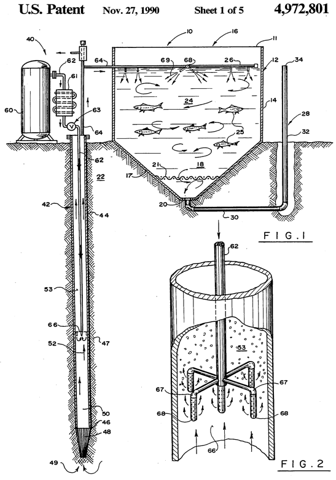
Robert’s aquaculture work led to a patented system combining oxygen enrichment with gas-lift pumping. Oxygen introduced into well water helped lift the water toward the surface while supplying oxygen for aquatic life.
U.S. Patent 4,972,801, issued November 27, 1990, documents this work. The system connected practical fish-farming requirements with fluid movement, pressure, and oxygen delivery.
Robert’s account of Redfish Hatchery describes an oxygen-distribution system serving 140 acres of ponds. The facility used geothermal well water, oxygen gas-lift pumping, and mixing valves to maintain oxygen levels throughout the operation.
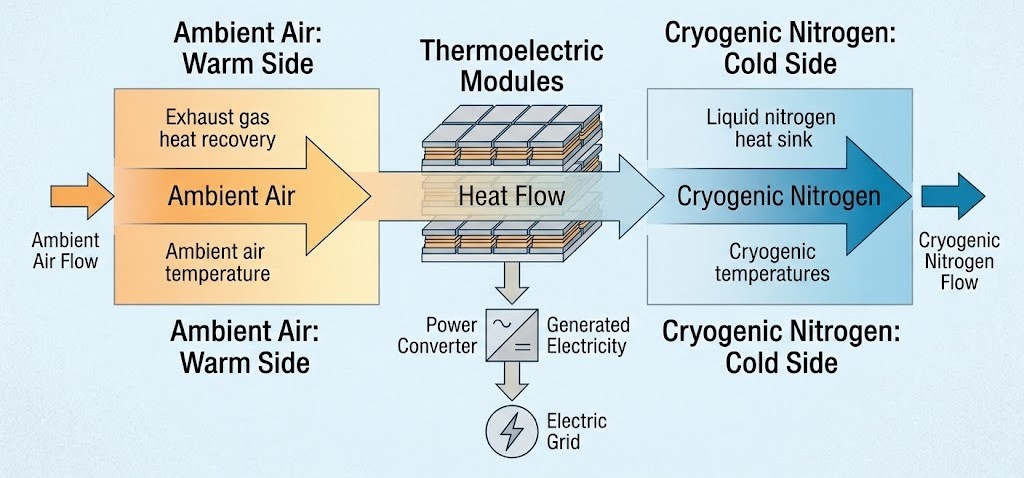
According to Robert’s account, Air Liquide funded an earlier test unit that used ambient air on the warm side of thermoelectric modules and cryogenic nitrogen on the cold side. Heat passing through the modules was converted into electricity, with the unit reportedly producing 3 kW.
The project was not commercialized because of the cost of the modules and liquid nitrogen, together with module failures after repeated heating and cooling cycles.
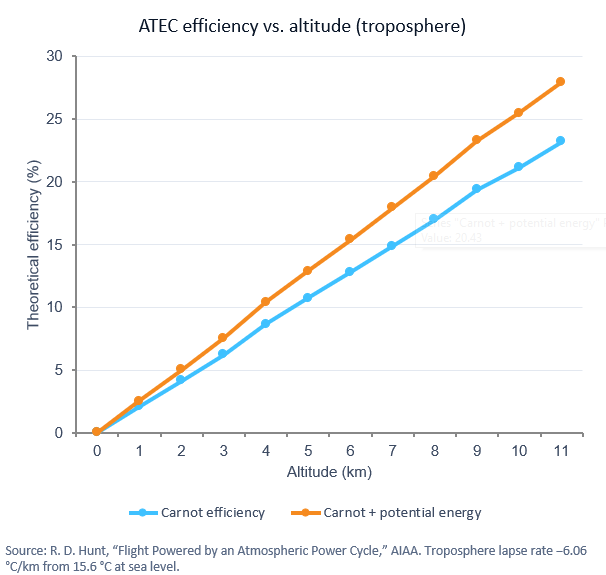
Robert’s AIAA paper, “Flight Powered by an Atmospheric Power Cycle,” describes Atmospheric Thermal Energy Conversion, or ATEC, and the GravityPlane concept.
The concept explores the temperature difference between warmer low-altitude air and colder air at altitude, together with buoyancy and gravity. Its proposed flight sequence uses changes in the lifting fluid to support climbing and descending, with ram-air turbines generating power during both phases.
This research forms part of the background to Robert’s continuing interest in atmospheric heat as an energy resource.
U.S. Patent 4,972,801
“Pumping System for Producing Oxygen Enriched Water Useful in the Growing of Aquatic Life.” Filed August 15, 1988; issued November 27, 1990.
“Flight Powered by an Atmospheric Power Cycle.”
An AIAA paper describing Atmospheric Thermal Energy Conversion and the GravityPlane concept.
Geothermal Resources Council paper, 2010.
Research described in the presentation as examining gravity-assisted gas lift in geothermal and solar-thermal systems.
U.S. Application No. 19/755,207
“Heat Energy from Ambient Air Harnessing.” Filed July 27, 2026.
AirPower is seeking development partners, licensees, and investors to support testing, prototype development, and potential applications. Explore the proposed technology or contact the team to discuss participation in its next stage.