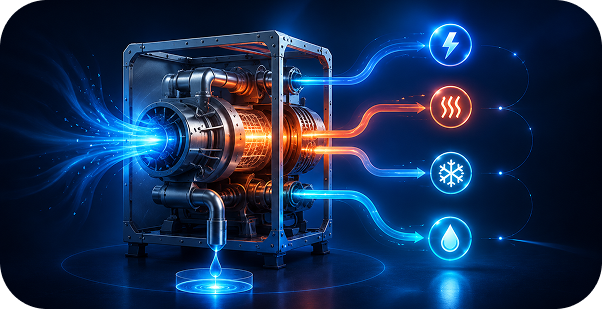

AirPower is built around a simple question: what if atmospheric air could play a role in producing useful energy? The concept developed by inventor Robert D. Hunt explores high-level compression of atmospheric air to create a higher-temperature heat source that can drive a heat engine through a hybrid power cycle. The proposed approach brings compression, heat, expansion and energy conversion together in one Thermodynamic System.
At the center of the concept is Air Power generated through the controlled use of compressed air and heat. Client materials describe atmospheric air being compressed, with the resulting heat used as part of a heat-driven power cycle. The concept considers a slower compression process, allowing the thermodynamic process to work over time. Some power-output details remain proprietary and are not disclosed publicly.
The goal is not simply to produce Electricity. The proposed system is designed around useful outputs, including Cooling And Fresh Water. As air is processed and cooled, moisture may be condensed and collected. That creates a potential role for Atmospheric Water Generation, although water availability would depend on moisture content and operating conditions.
AirPower is being considered for environments where power, cooling and resource use are closely connected. Data Centers are one application because they require large amounts of electricity while producing heat that must be managed. The proposed feedback loop has AirPower supplying electricity, cooling and ventilation while data center heat could be returned to the system as a potential heat source.
The same thinking can extend to Industrial Facilities, Manufacturing, and a Manufacturing Firm. This creates opportunities to explore Industrial Heat Recovery, Distributed Power Generation, and Energy Efficiency Solutions within larger energy systems.
The AirPower concept comes from Robert D. Hunt, an inventor and engineer whose work has included thermodynamics, power cycles and mechanical systems. Client materials state that Hunt began his design and engineering career in 1969 and worked on reactor components associated with the USS Nimitz. His work has also included aquaculture oxygenation systems, free-piston engine designs, solar building materials and the 2005 Gravity Plane concept.
His experience provides the foundation for the thinking behind AirPower, but the technology still requires engineering, modeling, testing and development before commercial performance can be established.
AirPower is currently seeking technical, manufacturing and investment relationships. The next stage may involve engineering firms, universities, Research Institutions, manufacturers, licensing partners and organizations experienced in power generation. Client materials identify opportunities for manufacturing agreements, partnerships, licensing, facility development and thermodynamic modeling of the hybrid power cycle.
AirPower is not presented as a completed commercial system. It needs technical evaluation, testing and practical engineering. The website explains the concept, its potential applications and the opportunity to participate in development without revealing proprietary technical details.
Learn more about Robert D. Hunt, Sr.’s career, selected inventions, aquaculture systems, custom engine development, and atmospheric thermal-energy research. His biography traces the engineering work and ideas that preceded the AirPower concept.
AirPower brings together Clean Energy Technology, Clean Energy Infrastructure, power generation, cooling and potential water recovery in one proposed platform. For organizations exploring Clean Energy and new approaches to industrial heat and resource use, this is an opportunity to examine the concept and help determine where it can go next.