Draft for approval by Robert D. Hunt, Sr. and Thomas St. Paul Keaty, II.
The executive summary and the release are designed to be read together: the release announces; the summary explains.
AirPower, LLC Files U.S. Patent Application on Engine Designed to Run on the Heat in Ambient Air
Dual-cycle CO₂ machine invented by veteran nuclear and mechanical engineer Robert D. Hunt, Sr. is designed to produce electricity, heating, cooling, refrigeration, and fresh water from the atmosphere, day and night, anywhere in the world
LONG BEACH, Mississippi — September __, 2026 — AirPower, LLC today announced the filing of U.S. Patent Application No. 19/755,207, “Heat Energy from Ambient Air Harnessing,” covering a new class of heat engine that draws its energy from the ordinary warmth of the air around us.
The application was filed with the U.S. Patent and Trademark Office on July 27, 2026 by the Keaty Law Firm of New Orleans and names Robert D. Hunt, Sr., founder of AirPower, as inventor.
The atmosphere is a vast store of solar energy. Sunlight warms the Earth’s surface every day, and the surface radiates that warmth into the air, where it remains through the night.
Unlike wind and sunlight, the heat in ambient air is available everywhere, at every hour, in every season. Engineers have long recognized it as a renewable resource; the difficulty has been building a practical machine to harness it. AirPower’s patent application discloses one.
The invention pairs two thermodynamic cycles. A closed cycle uses carbon dioxide, which has the highest vapor pressure of any practical working fluid, to drive a piston that compresses atmospheric air.
Compression raises the air to high temperature — the patent’s calculations show ambient air pre-heated to 500 °F reaching nearly 2,000 °F at only 395 psi — and that heat is captured in molten-salt phase-change recuperators, which store it for up to a week and use it to pre-heat the next charge of air.
The compressed air is then released through a cascade of accumulators at stepped pressures. At the top of the cascade, turbo-expanders generate electricity and discharge air at near-cryogenic temperatures; the middle tiers deliver mechanical power for air motors, propulsion, and tools; the lowest tier supplies space cooling and fresh air.
As the compressed air is cooled, the moisture it carries condenses out as potable water.
AirPower, LLC
The machine’s central feature is a pair of diametrically opposed CO₂ cycles, mirror images of one another, operating a half-cycle apart on a common shaft.
When both sides are at the same temperature their forces cancel; heating one side while cooling the other is what moves the shaft.
A feedback loop between the hot compressed air and the CO₂ reservoir means that each stroke compresses harder and runs hotter than the one before, up to the top of the stroke.
The design objective is a machine that, once started, sustains itself on ambient air alone, recharging its own recuperators on every stroke and generating its own electricity for valves and controls.
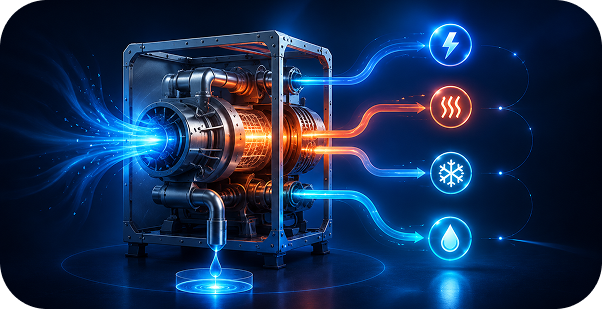
A single AirPower unit is designed to deliver, with no fuel, no combustion, and no chemical refrigerants:
Heating, from the heat formed during compression of the air;
Cooling, refrigeration, and freezing, from the expansion of high-pressure compressed air;
Ventilation, using low-pressure compressed air as the final stage;
Water, condensed from the water vapor in the atmosphere; and
Mechanical force converted to work — stored compressed air generating electricity, powering propulsion on land through compressed-air engines and in the air through compressed-air-driven propellers, and driving a large variety of power tools such as air-powered saws, drills, sanders, and paint sprayers.
The company sees immediate applications in off-grid and remote communities, disaster relief, agriculture and aquaculture, cold storage and industrial refrigeration, and water-scarce regions.
The engine’s outputs also move things.
Its compressed air can drive propulsion directly — air motors turning the propellers of a ship or an aircraft, or air-driven turbofan jets — and its electricity can drive propulsion the way a Tesla’s battery drives its motors, through electric motors on propellers, on the rotors and fan blades of vertical-lift aircraft, and on the drive shafts of vessels.
In either form the fuel is the heat in the surrounding air, so range is limited by the machine, not by a tank.
Mr. Hunt sees the AirPower engine as the natural power supply for the electric drive of his GravityPlane — the fuel-less aircraft described in his AIAA paper — which as a cargo vessel could carry massive loads without fossil fuel.
AirPower believes the largest near-term market is the data center.
The computing boom has run into two hard limits: electricity and water.
A large data center draws as much power as a small city and consumes millions of gallons of water a year for cooling, and communities across the country have begun to push back — with moratoria, denied permits, and outright bans — out of concern that their limited water supplies will be drawn down and their electric bills will rise, particularly where operators have been granted tax abatements that shift the cost of new generation and transmission onto local ratepayers.
The AirPower engine addresses both objections at once.
It produces its own electricity on site from ambient air; it produces the deep cold that server halls require directly, without evaporative cooling towers; and it produces fresh water from the atmosphere rather than drawing it from municipal wells and rivers.
A data center built around AirPower technology would take no water from its neighbors and no power from their grid — turning the two arguments used against new data centers into arguments for them.
And the relationship runs both ways: the very chips that make a data center hard to power and cool reject large amounts of heat, and that heat becomes a supplemental heat source for the AirPower engine, adding to the heat it draws from the air.
The chips give heat to the engine; the engine gives electricity, cooling, and water back to the data center — a closed loop in which the data center’s biggest waste product becomes part of its own power supply.
“Air is the ultimate renewable resource,” said Robert D. Hunt, Sr., founder of AirPower, LLC. “It is around us every moment of every day, carrying the sun’s heat, and it never stops. I have spent more than fifty years designing power systems, from the reactors on the Nimitz-class carriers to megawatt-class custom engines, and this is the machine I have been working toward. It turns the heat in the air into everything a community needs to live: power, warmth, cold, and clean water.”
Robert D. Hunt, Sr. brings 56 years of nuclear, mechanical, and thermodynamics engineering to the invention.
Hired in 1969 into the newly created nuclear engineering department at Newport News Shipbuilding and Dry Dock Company, he served as group leader for the design of the nuclear reactors and power train of the Nimitz-class aircraft carrier — a design that went essentially unchanged for more than twenty years and carried every Nimitz-class carrier built but the last.
He went on to design and build a large number of custom engines, many in the megawatt range, and is the inventor of the exhaust-actuated free-piston engine commercialized through Linear Power Ltd.
Mr. Hunt is also a pioneer of marine aquaculture: in the fall of 1986 he and his wife at the time became the first people to spawn redfish — a saltwater species — commercially, and their company, Redfish Hatchery, Inc., was for years the only commercial supplier of redfish fingerlings in the world, shipping extensively to South America, Israel, Europe, and to partner operations across the United States.
The hatchery itself was a showplace that drew bus tours from the regional aquaculture shows: 140 acres of ponds fitted with miles of one-inch copper tubing carrying pure oxygen from a thirty-foot cryogenic tank supplied by Air Liquide, and wells — permitted to draw seven million gallons a day of constant-temperature geothermal water — whose flow the oxygen gas-lifted into round ponds, where mixing valves held the water at 10 ppm dissolved oxygen and a circular current supported fish densities so thick that, as Mr. Hunt puts it, you could almost walk on them.
His first patent, U.S. 4,972,801 (1990), is that system: expanding oxygen bubbles gas-lifting and oxygenating well water for growing fish.
The relationship with Air Liquide later produced Mr. Hunt’s first machine to make power from the air: a thermoelectric generator, funded by the company, that flowed cryogenic nitrogen across one face of solid-state thermoelectric modules and ambient air across the other, so that the heat in the ambient air passed through the modules and was converted directly into electricity.
The test unit produced three kilowatts — enough for a home — and drew interest from other gas companies wanting several thousand units to power telemetry on remote tanks, though the cost of the modules and of liquid nitrogen kept it from commercial production.
In the 2000s he filed a series of patent applications on airships and aircraft powered by buoyancy and gravity, built airships to prove the concept, and, in a paper for the American Institute of Aeronautics and Astronautics, introduced Atmospheric Thermal Energy Conversion — the same energy source the new AirPower engine is designed to harness.
He is Chairman of Hunt Aviation Corporation and a member of the AIAA.
AirPower, LLC is seeking development partners, licensees, and investors for pilot deployments.
All licensing requests and intellectual-property inquiries arising from this announcement are being handled by the company’s patent counsel, Thomas St. Paul Keaty, II, of the Keaty Law Firm, One Canal Place, 365 Canal Street, Suite 2410, New Orleans, Louisiana 70130.
Telephone: (504) 524-2100
Facsimile: (504) 524-2105
Mr. Keaty, registered to practice before the U.S. Patent and Trademark Office since 1974, has prosecuted hundreds of issued U.S. patents and has represented Mr. Hunt for decades.
AirPower, LLC, of Long Beach, Mississippi, was founded by Robert D. Hunt, Sr. to develop and license technology that harnesses the heat energy in ambient air.
Its patent-pending dual-cycle engine is designed to produce electricity, heating, cooling, refrigeration, fresh water, and mechanical power from the atmosphere, continuously and off-grid.
Learn more at airpowerllc.com.
Performance figures cited in this release are derived from the thermodynamic analysis in the patent application and represent design objectives and theoretical limits; they have not yet been demonstrated in an operating prototype.
AirPower’s next steps include construction of a high-pressure CO₂ test stand and an instrumented prototype of the dual-cycle engine.
AirPower brings together Clean Energy Technology, Clean Energy Infrastructure, power generation, cooling and potential water recovery in one proposed platform. For organizations exploring Clean Energy and new approaches to industrial heat and resource use, this is an opportunity to examine the concept and help determine where it can go next.